
I run a government AI delivery team of 40 people. We use AI to save millions of public dollars, and to make each government employee about 10x more effective at the work that still needs a human.
That sentence is incomplete without the next one.
There are things we will not automate. Not because we are timid. Because some work is the public's last line of defense, and a model cannot stand in that line.
The bright line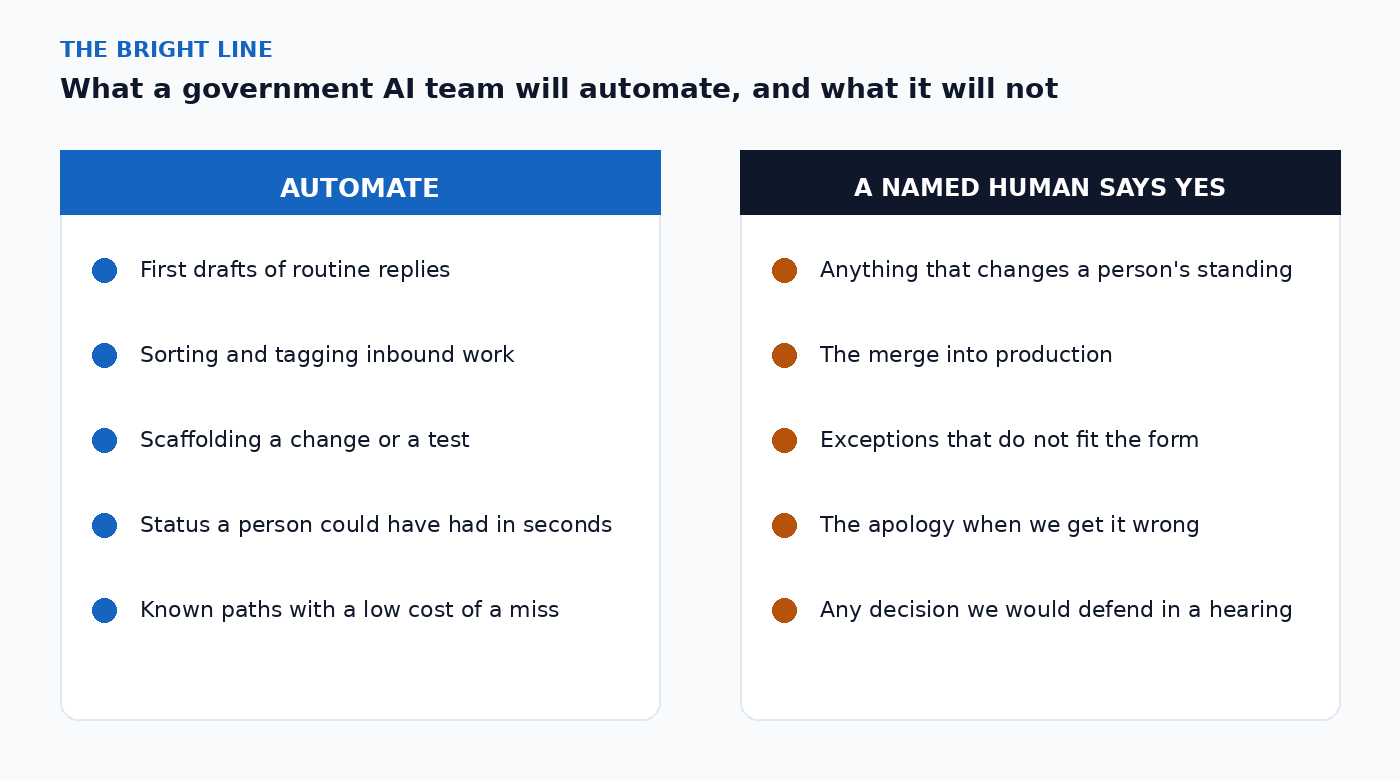
Hold us to this list. If we cross it, say so.
What we will take
- The first draft. A routine reply, a tagged record, a scaffolded change. Unfinished work, done faster.
- The wait that is just a wait. Status a person should not have to sit three days to learn.
- The known path. Where the cost of a miss is low and the pattern is already written down.
What we will not take
- A changed life. Identity, eligibility, enforcement, anything that alters a person's standing. The system may assemble the file. A named human signs the decision.
- The merge. A change can be generated in minutes. It does not become real until a person puts it on the path to production.
- The exception. Real life arrives sideways. Exceptions are not edge cases in public service. They are the job.
- The apology. When we get it wrong, the public does not want a log file. They want a name.
If we cannot explain a recommendation in plain language, it does not go forward. Opacity is a stop sign.
What we are asking of you
Tell us where a machine is fine, and where you still want a person. Be specific. "AI in government" is too big a sentence to have a useful opinion about.
The takeaway: Efficiency is a public good. So is a list of things we refuse to hand over.
What belongs on the "will not automate" list that we missed? Reply with a real example. We read them.