People do not distrust government AI because they hate technology. They distrust it because they have been on the wrong side of a confident system before.
Bias is not a defect you find in week one and close. It is a property of data, of design, and of who was in the room. Treat it like a patch and it will come back as a headline.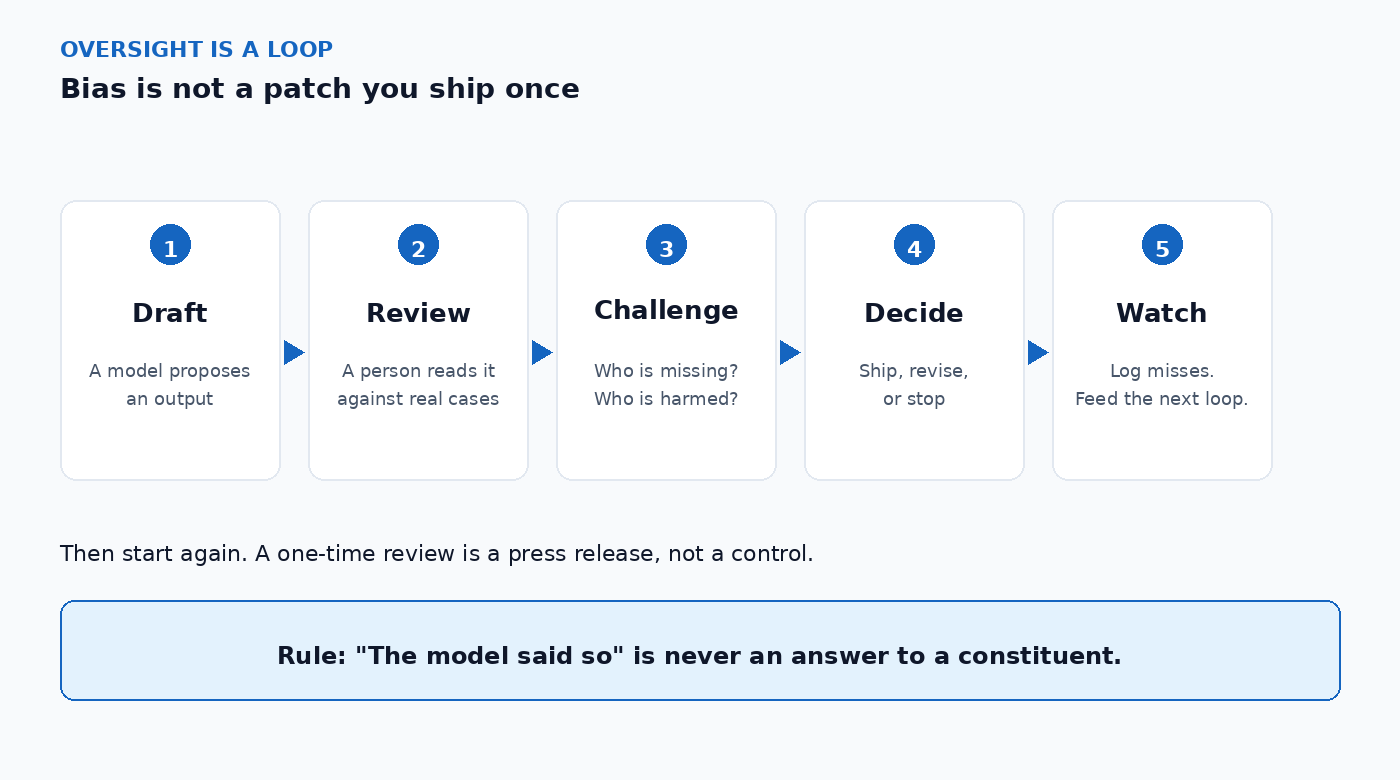
Oversight is a loop
- Draft. A model proposes an output. That is the start, not the decision.
- Review. A person reads it against real cases, not a happy-path demo.
- Challenge. Who is missing from the data? Who is harmed if this is wrong?
- Decide. Ship, revise, or stop. Stopping is a success when the output cannot be defended.
- Watch. Log the misses. Feed them into the next loop. A review with no memory is theater.
What we will not hide behind
- "The model said so." That is not an answer to a constituent, a reporter, or a hearing.
- A one-time fairness report dated the month we launched.
- A checkbox that says a human looked, when the human had no time and no training to disagree.
On a team of 40, the scarce skill is not prompting. It is the person who can look at a clean, confident output and still ask who it leaves out.
What we are asking of you
If you have been on the wrong side of an automated decision, tell us what a real review would have caught. If you run a team, tell us how you train people to disagree with a model.
The takeaway: Fairness is not a release note. It is a habit with a name on it.
Where have you seen "the model said so" used as a close? We want the real cases, not the theory.